
How much does a bank charge to send money to Türkiye?
Your own bank is often the first place you think of when sending money to Türkiye. But a bank transfer to Türkiye isn’t like a transfer to another German account, and the fees work differently. Here’s what can be charged, who pays it, and how to find out what your bank really costs.
Why a transfer to Türkiye isn’t a SEPA transfer
Within the SEPA area, euro transfers are usually cheap or free. Türkiye isn’t part of SEPA, so your bank sends the money as an international SWIFT payment. It can pass through one or more correspondent banks before it reaches the recipient’s bank, and the euros usually have to be converted to lira somewhere along the way.
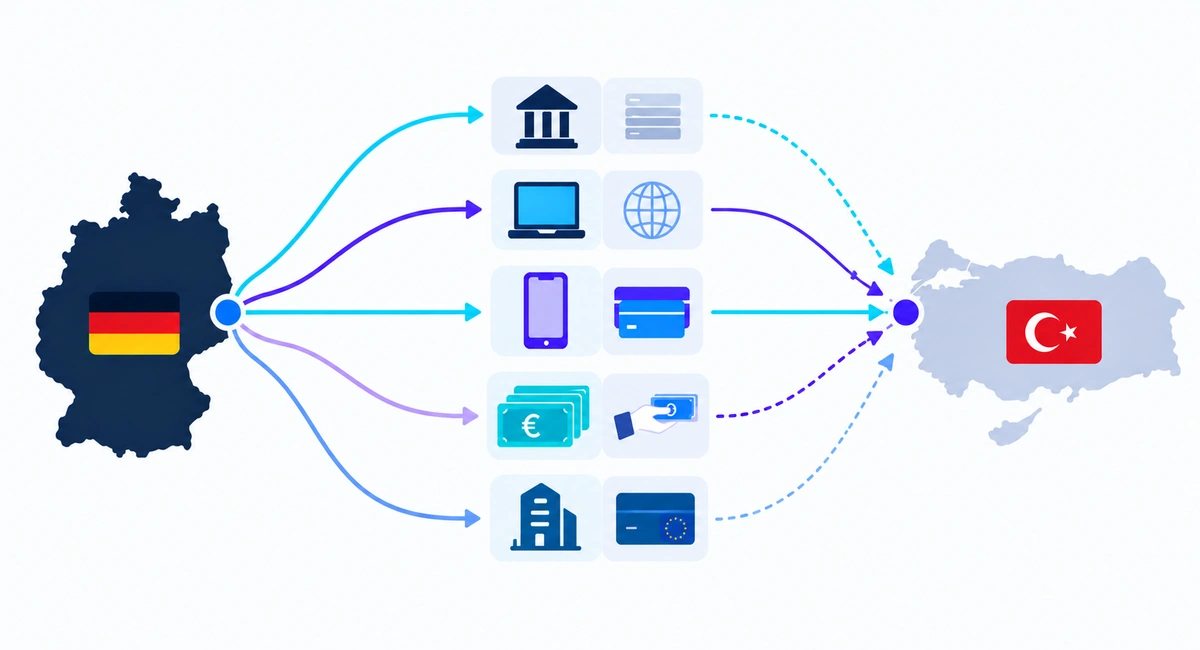
The four cost layers
- Sending fee. Your German bank charges for the international transfer. It’s often a percentage of the amount, with a minimum and maximum, and can be higher for paper orders than for online banking.
- Correspondent bank fees. Banks that pass the payment along may deduct their own fee. You often can’t see this when you send.
- Receiving fee. Some Turkish banks charge for incoming international payments.
- Exchange rate spread. If your bank or the receiving bank converts the money, it uses its own rate, usually below the mid-market rate. On larger amounts, this is often the biggest cost.

The first fee is easy to find. The other three are what make bank transfers to Türkiye surprisingly expensive.
SHA, OUR and BEN: who pays which fee
When you send via SWIFT, you choose a charge option:
- SHA (shared): you pay your bank’s fee; correspondent and receiving fees are deducted from the amount. This is the usual default.
- OUR: you pay all fees. It costs more upfront, and the full amount still isn’t always guaranteed to arrive.
- BEN (beneficiary): your recipient pays all fees, deducted from the amount.
With SHA and BEN, your recipient gets less than you sent, even before any conversion.
How to check what your bank charges
- Look up foreign payments in your bank’s price list (Preis- und Leistungsverzeichnis), or ask your adviser.
- Ask which exchange rate the bank uses for euros to lira, and compare it with the mid-market rate.
- Ask your recipient to check their bank’s incoming payment fees.
- Ask whether correspondent fees are likely, and which charge option you’re using.
Then add everything up and compare it with the amount a transfer service would deliver. Our guide on exchange rates vs fees shows how to measure the spread.
How Paragotr models a bank transfer
In the calculator, the bank transfer is a benchmark, not a specific bank. It uses an illustrative profile of a typical German high-street bank with a sending fee, one correspondent fee, a receiving fee and an exchange rate spread. Each result shows the assumptions line by line. Fees vary by bank, so treat it as a reference point and check your own bank’s prices.
Ways to pay less
- Compare the amount received with transfer services before every larger transfer: SWIFT vs Wise vs TransferGo.
- Avoid double conversion. If the account in Türkiye is in lira, choose an option that converts transparently, rather than sending euros for the receiving bank to convert.
- Send fewer, larger transfers if your bank charges a high minimum fee.
- Check your account model. Some bank accounts include cheaper foreign payments.
Sample calculation: €1,000 and €5,000
The tables below show the bank benchmark next to the transfer services in our comparison, generated from our sample data. For your own amount, use the calculator for Germany → Türkiye and open the bank transfer’s details for a line-by-line breakdown.
Sample calculation
Calculated with Paragotr's sample data as of 30 September 2026, ranked by the amount received. Not live prices.
Sending €1,000 (Germany → Türkiye)
| Option | Recipient gets | Total cost | Estimated time |
|---|---|---|---|
| TransferGoWithin 24 hours | ₺51,532.93 | €8.98 | Within 24 hours |
| RevolutUp to 72 hours | ₺51,481.25 | €9.98 | Up to 72 hours |
| WiseWithin 24 hours | ₺51,477.40 | €10.05 | Within 24 hours |
| RemitlyWithin 24 hours | ₺51,428.00 | €11.00 | Within 24 hours |
| Typical bank (SWIFT)1 to 5 business days | ₺47,796.45 | €80.84 | 1 to 5 business days |
Sending €5,000 (Germany → Türkiye)
| Option | Recipient gets | Total cost | Estimated time |
|---|---|---|---|
| TransferGoWithin 24 hours | ₺257,868.93 | €40.98 | Within 24 hours |
| WiseWithin 24 hours | ₺257,501.40 | €48.05 | Within 24 hours |
| RevolutUp to 72 hours | ₺257,406.24 | €49.88 | Up to 72 hours |
| RemitlyWithin 24 hours | ₺257,140.00 | €55.00 | Within 24 hours |
| Typical bank (SWIFT)1 to 5 business days | ₺248,516.45 | €220.84 | 1 to 5 business days |
Sample data modeled on public fee structures and an illustrative mid-market rate. Your bank or card issuer may charge extra fees. Delivery times are estimates, not guarantees. In the calculator, Wise shows a live price where available, which can differ from these figures.
Figures in this guide are illustrative, not live prices. Fees and exchange rates change and vary by provider and bank. This guide is general information, not financial or legal advice. Some provider links are affiliate links; they never affect our rankings. How we compare:Our method